
The First Principle
Why every art form, and every act of leadership, comes back to a story

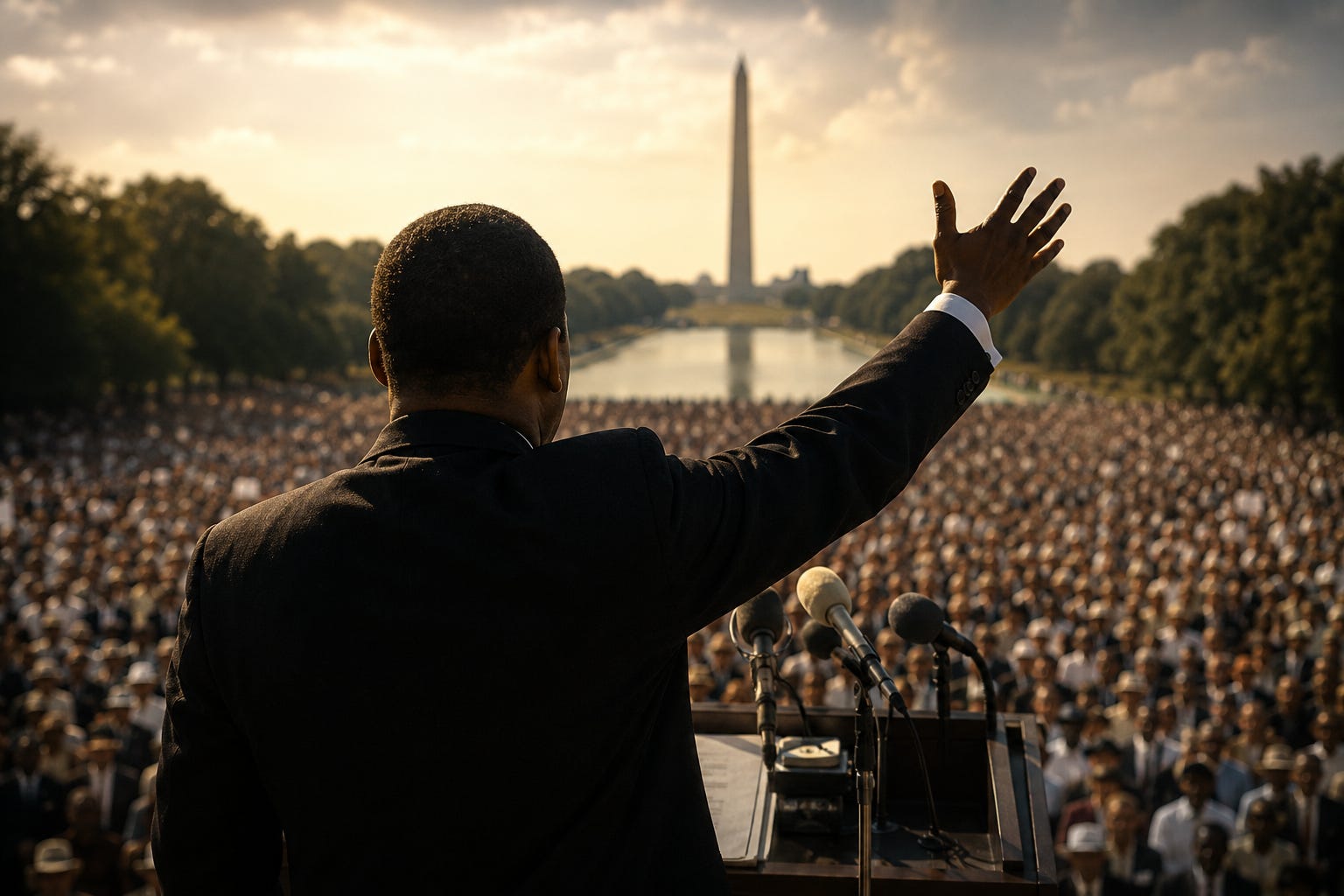
On the afternoon of August 28, 1963, Martin Luther King Jr. was reading from a prepared text on the steps of the Lincoln Memorial. By most accounts the speech was solid. It had the policy. It had the moral indictment. It had the rhythms King had sharpened across years of pulpits and protests. What it did not yet have was the part everyone now remembers.
According to Clarence Jones, the lawyer and confidant who helped draft the original remarks, the most famous passage in twentieth century American oratory was not in the text. Mahalia Jackson, the gospel singer who had performed earlier that day, was sitting on the platform behind King. Somewhere in the middle of the address, she called out to him, loud enough to be heard: “Tell them about the dream, Martin.” Jones recalls watching King set the prepared pages aside. What followed was improvised. The dream of children walking together. The dream of mountains made low and valleys lifted up. The dream that was rooted in the American dream.
The data of injustice was already on the page. The story was not. And it was the story that changed America.
I have been thinking lately about why this is. About why a story, told well, can do work that no amount of evidence will ever do. About why most of what I remember from a career of meetings and decks and offsites is not the bullet points but the moments someone told me a story I had never heard before. A story is not a leadership technique. It is something more fundamental than that. The story itself, I want to argue, is the first principle of all art, of which leadership is one. And once you see it, you cannot unsee how much it explains.
The first principle
Let’s start with the obvious cases. Literature is stories. Novels, short fiction, narrative nonfiction, memoir, biography. Poetry too, even the spare imagist poems and the haiku, which compresses an entire scene into seventeen syllables and asks you to fill in the rest. Drama is stories acted out. Film and television are stories projected. None of this is controversial.
But push outward. A painting is a single frame of a story. Edward Hopper’s diner at midnight is asking you who those four people are, what brought them there, what they will not say to each other. The Mona Lisa is asking what she is thinking, and the fact that we still cannot answer is precisely why she is famous. Rodin’s Thinker is mid-thought, which is to say mid-story. Even photography, the most documentary of forms, is a frozen instant of something that came before and something that will come after.
Music is harder, but I think it works the same way. A song has tension and release, verse and chorus, a build and a payoff. Even instrumental pieces with no lyrics carry an emotional arc, which is what an arc is for. The reason a Coltrane solo or a Beethoven adagio can move us is that it is enacting something, going somewhere, even if where it is going cannot be put into words.
Pottery and ceramics tell the story of a hand shaping a material into something useful, and then the story of the meal that bowl will hold, and then, eventually, the story of being unearthed by an archaeologist who tries to reconstruct the people who used it. Architecture tells you what its makers thought mattered. The cathedral and the strip mall are arguing about different stories, and you can read the argument in the materials and the proportions if you know how to look.
The point is not that art uses stories. The point is that story is what art is.
The operating system
There is a reason for this, and the reason is us. Humans do not actually think in spreadsheets, even when we pretend to. We think in stories. The literary scholar Jonathan Gottschall makes this case in The Storytelling Animal, drawing on cognitive research showing that narrative is not a thing the brain does occasionally. It is closer to the format the brain runs in. We turn weather into stories about luck. We turn coincidences into stories about fate. We turn quarterly numbers into stories about strategy.
Princeton researchers have shown that when one person tells a story and another person listens, the listener’s brain activity begins to synchronize with the storyteller’s. Not just in the language regions, but in regions associated with emotion and prediction. The teller and the listener are not really two people anymore for the duration of the story. They are running the same simulation. I think this is also what happens when you stand in front of a painting that grabs you, or when you finally hear what a song was trying to tell you. The art is not finished in the canvas or the recording. It is finished in you.
Which raises a fair objection. What about the art that seems to refuse this entirely? What about a Rothko canvas of nothing but color fields, or a piece of late Coltrane that abandons melody, or the cold concrete of a Brutalist building? Where is the story there?
I think the honest answer is that the viewer brings one. The art that appears to reject narrative is actually betting on it, betting that you will supply the story it withholds. Stand in front of a Rothko long enough and you will start telling yourself something. The piece is incomplete until you do. Which is, in its own way, an even stronger version of the thesis. Story is so foundational to how we make sense of anything that even art designed to refuse it gets re-storied by the people experiencing it. There is a Hopi proverb worth remembering here: those who tell the stories rule the world. The corollary is that the world is always being told stories, whether or not anyone is consciously telling them.
The leader as curator
Bring this back to leadership, because it is the same observation. Managing and leading are not the same thing. Managing is about tasks, deadlines, dependencies, and the mechanics of getting work done. Leading is about meaning. A junior engineer who frames a thorny project as a chance for the team to finally build something they will be proud of is leading, even without anyone reporting to them. A senior vice president who only talks about deliverables and dates is managing, even with hundreds of people on their org chart. The difference is not seniority. The difference is whether you are giving your team a story to live inside while the work gets done. And meaning travels in stories.
The Mahalia Jackson moment is the proof. King had the data. He had the structure of the march, the coalition, the years of preparation. He had a prepared text that was, on its own merits, a perfectly competent speech. What he did not have, until prompted, was the story. The story is what turned a march into a memory.
The same dynamic shows up everywhere if you look. Apple’s 1984 commercial was not a product specification. It was a two minute David and Goliath myth, with the Macintosh cast as the rebel hammer thrown at a screen full of conformity. The commercial was the story; the product was almost incidental to the launch. Howard Schultz, returning to Starbucks during the 2008 collapse, did not lead with operational fixes, although those came. He led with a story about who Starbucks was and what it had forgotten about itself. Shackleton, before the Endurance ever sailed, was already trafficking in the story of his expedition; whether or not the famous “men wanted for hazardous journey” advertisement was ever actually printed (and the historical evidence suggests it probably was not), the story of the ad has done more leadership work in the century since than most things that were actually said. Even an apocryphal story can rally people, which tells you something about how thin the membrane is between leadership and narrative.
Every leader is a curator of stories whether they realize it or not. The buildings you choose to put your team in. The logos on the laptops. The all hands rituals. The way someone’s departure is talked about, or not talked about. Every one of these is a fragment of a story that your team is reading, even when you are not consciously writing it. The risk is that if leaders do not author the story, someone else will. Usually badly. In the absence of a coherent narrative from the top, every team writes its own, and they do not agree with each other, and the disagreements show up as politics, which is what we usually call story conflict when we are too tired to name it correctly.
A caveat worth keeping
Not every story is worth telling. The history of leadership is also a history of dangerous narratives. Nationalist myths. Demagogue arcs. The manipulative “us against them” that has been used to sell every cruelty humans have ever talked themselves into. Story is a tool. Like all tools, it has no ethics of its own.
So the question is not whether a leader is telling stories. They are, always, including the leaders who insist they are just dealing with the facts. The question is whether the stories are true, whether they are generative, and whether they are worthy of the people being asked to live inside them. Those are different tests, and a story can pass one and fail the others. A leader’s job is to keep checking all three.
Tell them about the dream
Here is what I want you to do this week. Ask yourself what story your team is telling itself about who they are. Not the mission statement on the wall. Not the OKRs in the deck. The actual story your people would tell each other if you were not in the room. The version that gets told over a beer after the offsite, or in the side channel during the boring part of the meeting.
If you do not know the answer, your team is writing one without you, and it may not be the one you would have written. If you do know the answer and you do not like it, you have a chance to change it. Not with another deck. Not with a memo. Not with a values poster in the break room. With a story. The kind that someone could repeat to a new hire on their first day and have it land.
Somewhere on your team there is someone waiting for you to set the prepared text aside and tell them about the dream. The only question that matters is whether you have one to tell.