
Spikiness
Ups and downs, trust the process

In 1932 a future music star was born in Arkansas during the Great Depression. As the son of a cotton farmer, his early life was quite hard. After a stint in the Air Force, he wound up in Memphis and walked into Sun Records stating he wanted to record a song. He ended up recording a number of songs such as “I Walk the Line” and “Folsom Prison Blues.” Suddenly he was famous.
Unfortunately, after a few years of fame, the wheels started coming off. Endless touring, insomnia, addiction. Arrests. Car wrecks. He once crawled into a cave in Tennessee and lay down, ready to die.
He met a woman named June Carter who would eventually become his wife. She helped save him from himself. In 1968, after recovery, he recorded At Folsom Prison. It wasn’t just a comeback album. It was a complete return. His career again took off.
Yet again by the 1980s, the industry had moved on. He was dismissed as a relic, out of step with the times. And then came Rick Rubin, a hip-hop and metal producer who saw what was still there. Rubin stripped everything back. Just a guitar, a mic, and a singer. The result was the album American Recordings.
You have probably guessed by now that this singer was Johnny Cash. He and his wife, June, died just months apart in 2003.
Cash has an incredibly spiky career. It lurched and veered, rising fast, crashing hard. But, there are lessons that we can all learn from such a life:
Authenticity wins. Every time Cash found his voice again, it was by stripping away everything fake.
Pain can be fuel. The darkest chapters became his most powerful songs.
Evolution is survival. He kept changing without losing his center.

Most companies tell their story like a straight line: a steady climb from humble beginnings to inevitable success. But if you zoom in on any truly great company, the graph looks a lot messier, jagged peaks, deep valleys, near-death moments, and improbable rebounds. The real story of innovation isn’t smooth; it’s spiky.
Apple is a perfect example.
In the late 1970s, it exploded out of a California garage, reshaping personal computing almost overnight. By the mid-1980s, though, Apple had lost its way. Steve Jobs was forced out, the product line ballooned, and the company that once symbolized creativity drifted toward irrelevance. By 1997, Apple was ninety days from bankruptcy.
And then, the spike upward: Jobs returned. He simplified everything, fewer products, cleaner design, sharper focus. The iMac, iPod, iPhone, and a cultural revolution followed. Apple’s resurgence wasn’t a gentle recovery; it was a reinvention born out of collapse. It succeeded not because it avoided volatility, but because it used the lows to rediscover what mattered.
Netflix followed a similar pattern.
It started by mailing DVDs, a clever but niche business. When streaming came along, Netflix bet everything on the future, effectively blowing up its own model. The transition was brutal. In 2011, the infamous “Qwikster” split sent customers fleeing, the stock crashed 75%, and analysts wrote its obituary.
Yet within a few years, Netflix had reinvented itself again, this time as a global studio. “House of Cards,” “Orange Is the New Black,” and “Stranger Things” weren’t just shows; they were proof that the company had transformed from distributor to creator. The very dip that almost killed Netflix became the crucible that made it unstoppable.
Spike Pattern
These stories share a pattern: the spike. Rapid rise, sharp fall, reinvention. It’s the rhythm of progress in real life, unpredictable and often painful, but necessary. When you look at the lives of people like Johnny Cash, or companies like Apple and Netflix, you start to notice a pattern that feels both inspiring and uncomfortable. It’s spiky. There are dramatic highs, painful lows, and not much in between. That’s the essence of spikiness: progress that doesn’t move in a straight, predictable line, but lurches forward through moments of chaos and reinvention.
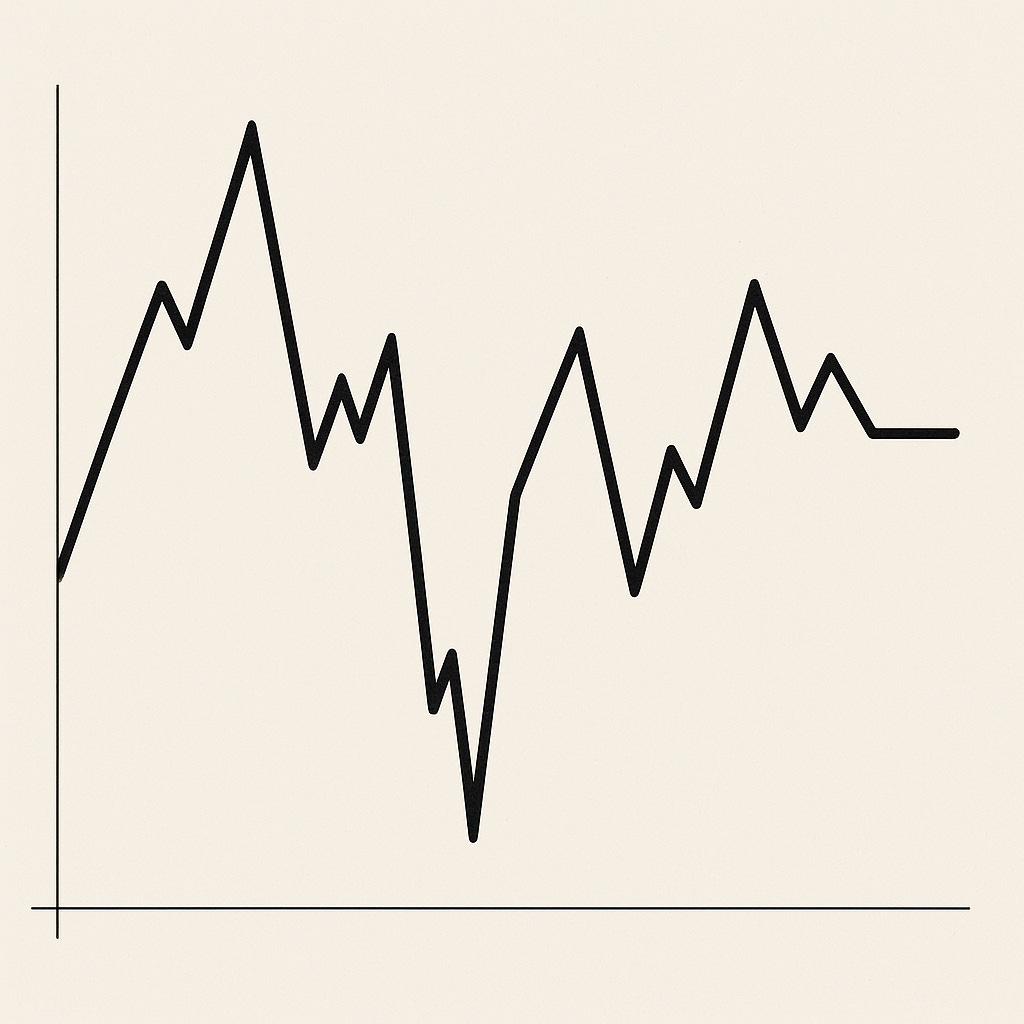
We often talk about success as if it’s a smooth, upward slope, each quarter better than the last, each career step neatly building on the one before it. But real growth, whether in art, leadership, or business, rarely looks like that. It looks more like an erratic heart monitor: bursts of brilliance followed by crashes, pauses, recoveries, and the occasional flatline before the next surge. The spikes are where the learning happens.
Spikiness is uncomfortable because it resists control. It doesn’t fit into forecasts, dashboards, or tidy narratives. When a company hits a dip, people panic, investors get nervous, teams lose confidence, leaders question themselves. When a person hits a dip, it feels like failure. But in truth, the dips are often just part of the rhythm. Without them, there’s no space for reflection, correction, or discovery.
The irony is that the smoother we try to make things, the more fragile they become. In creative work, in startups, in leadership, the pursuit of “smooth” often means sanding off the very edges where innovation lives. Johnny Cash didn’t make his best music during the easy stretches. Apple didn’t innovate by maintaining a steady climb. Netflix didn’t redefine entertainment by playing it safe. The spikes, the crises, the reinventions, the messy in-betweens, are the source of renewal.
Spikiness isn’t something to be avoided. It’s something to be understood. It’s the shape of progress when you’re doing something that actually matters.
If spikiness is where the real growth happens, then why do we spend so much energy trying to avoid it? Why do we build systems, plans, and processes designed to sand away every bump?
It’s because smoothness feels safe. It gives the illusion of control. In business, we celebrate predictability, steady revenue, reliable growth curves, incremental progress. The very language of management is built around smoothing things out: forecasts, pipelines, quarterly guidance, roadmaps. These tools help us sleep at night, but they also create a false sense of order in a world that’s fundamentally messy.
Our brains are wired for it. Psychologically, volatility reads as danger. Evolution taught us to flinch at unpredictability, to seek the stable ground. So when the metrics dip or the team stumbles, we interpret it as failure rather than a natural rhythm of creative work. We mistake turbulence for trouble.
Organizations reinforce that bias. As companies grow, they develop antibodies against chaos. Planning cycles, KPIs, and compliance reviews all have their place, but they tend to reward consistency over experimentation. The result is a culture that smooths out the spikes that could have led to the next big leap. A team that’s too focused on keeping the line straight may never discover what lies beyond it.
Leaders aren’t immune either. A rough quarter, a failed product, a customer loss, these feel personal. Smoothness is comforting because it suggests control; spikiness feels like exposure. Yet the most resilient leaders, like the most resilient artists, understand that the line will never be flat. They learn to read the dips as data, not doom.
Smoothness seduces us because it promises safety. But safety is not the same as progress. The most interesting journeys, the ones that change industries, or hearts, or art forms, are inherently uneven. The work isn’t to eliminate the spikes. It’s to build the courage and systems to withstand them.
As Seth Godin wrote in The Dip, the hardest moments often separate those who quit from those who level up. The dip feels awful, progress stalls, attention fades, doubt creeps in, but it’s not the end. It’s the proving ground where the next version of you or your company is quietly taking shape.
Johnny Cash’s darkest moment was in that Tennessee cave. He went there ready to die, convinced his story was over. Instead, it became the place where he found renewal. Apple nearly went bankrupt before rediscovering simplicity. Netflix’s crash led directly to its reinvention as a studio. The dip wasn’t a dead end. It was the turning point.
Leaders who thrive through downturns don’t avoid the pain, they stay with it. They get quiet, get honest, and get curious. They ask: What’s this moment trying to teach me? What’s trying to emerge here that couldn’t exist before? That shift, from fear to curiosity, is where resilience begins.
It’s counterintuitive, but sometimes the best move in a dip isn’t to push harder. It’s to pause. To reflect. To strip away the noise and rediscover what’s essential. That’s how Cash found his sound again. That’s how great companies find their purpose again. The cave moments are never comfortable, but they’re often the crucible of the next breakthrough.
Every spike downward carries within it the seed of the next rise. The trick is knowing how to nurture it.
Authenticity wins. Every time Johnny Cash returned to form, it was by returning to himself, no filters, no gimmicks, just truth. The same goes for companies. When Apple simplified its product line, or when Netflix leaned into original storytelling, they weren’t chasing trends. They were reconnecting to what made them distinct in the first place.
Pain becomes fuel. The best rebound stories transform frustration into focus. The humiliation of failure becomes clarity. For individuals, that might mean rediscovering the joy of the craft; for organizations, it might mean reconnecting with customers, rethinking the mission, or rebuilding the culture from the inside out.
Evolution is survival. Reinvention doesn’t mean abandoning identity; it means allowing it to breathe. Cash didn’t stop being “The Man in Black” when he recorded American Recordings, he deepened it. The same way Netflix didn’t stop being an entertainment company when it stopped mailing DVDs. It became a fuller version of itself.
Spikiness isn’t about chaos for chaos’s sake. It’s about transformation. When we treat downturns as opportunities to evolve, not emergencies to avoid, we open the door to reinvention.
Leadership
Leadership during a spike, especially the downward kind, is an exercise in composure. Everyone looks to you when things wobble. Your reaction sets the tone for the entire organization.
The first task is to normalize the volatility. Remind your team: This is what building something real looks like. A smooth line isn’t proof of success, it’s often proof of stagnation. Setbacks, misfires, pivots, these are not detours from the path; they are the path.
The second task is to build emotional and operational resilience. Create systems that can absorb shocks: flexible budgets, cross-trained teams, short feedback loops. Encourage experimentation, but balance it with reflection. When people know that failure is survivable, even expected, they stop hiding it. That honesty becomes fuel for better decisions.
Finally, lead with humility and perspective. Admit when things are hard. Celebrate small wins. Stay grounded in purpose. Teams can handle volatility if they trust the direction. They only panic when they lose connection to the “why.”
Leadership in spiky times isn’t about smoothing the curve. It’s about helping people trust the process enough to ride it.
Conclusion
Johnny Cash’s life was a song with verses that didn’t always rhyme, bright highs, dark lows, and everything in between. But it was always true. That’s what made it timeless.
The same is true for companies, for teams, for creative work. The rhythm isn’t steady; it swells and dips, cracks and rebuilds. The spikes aren’t anomalies, they’re the heartbeat. They’re proof that you’re doing something alive, something that matters.
When you look back, the goal isn’t to see a smooth upward line. It’s to see a story worth telling, one with depth, texture, and transformation.
So trust the process. Welcome the spikes. They’re not signs that you’re off course.
They’re signs that you’re still in motion.
Hi Mike, I only found your blog today and really enjoyed this.
Your thoughts on spikiness hit home. A leader’s ability to stay steady during the messy parts of change makes such a difference. I’ve lost count of the times I’ve had to help calm things down in the middle of a big shift. Sometimes it’s just listening and letting people vent. Sometimes giving a clearer perspective. Or even just giving a simple pep talk to remind everyone it’s ok if the journey is messier and longer than we hoped for.
Looking forward to reading more of your writing.
And by the way, I tried to connect on LinkedIn but it asked for your email. Would love to connect there too. I’m a long-time MFP user and currently exploring my next role, so figured I’d reach out. Super big fan of what you’re building.
Thanks a lot Mike!