
Exploit vs Explore
What bees and casinos can teach us about product leadership

One of the recurring themes in this newsletter is that many of the problems we wrestle with in organizations are not new problems at all. They are ancient ones. Long before we had roadmaps, quarterly OKRs, or product portfolios, nature was already solving variations of the same challenges: how to allocate limited resources, how to balance efficiency with adaptability, and how to survive in environments that change faster than we’d like.
I wrote previously about the shape of leadership, drawing inspiration from birds in flight. What struck me was not that there is a single “right” formation, but that different birds organize themselves differently depending on conditions. Geese fly in tight V-formations to conserve energy over long distances, rotating the lead position as individuals tire. Starlings, by contrast, form murmurations, fluid, shifting clouds that respond instantly to predators and wind, prioritizing adaptability over efficiency. In both cases, there is no permanent leader pulling the group forward. Leadership emerges, recedes, and reshapes itself based on context. That piece resonated with many of you because it reframed leadership not as a role or a hierarchy, but as a living system tuned to its environment.
This essay builds on that same idea, but shifts the lens slightly. It’s about decision-making under uncertainty, and specifically the tension every product leader feels between exploiting what already works and exploring what might work next.
If that tension feels familiar, it should. It shows up every time you look at a roadmap and ask whether to double down on incremental improvements or carve out space for something riskier. It shows up when you decide how many teams should focus on reliability and optimization versus discovery and experimentation. And it shows up when success itself becomes the thing that makes future success harder.
Nature has not only struggled with this problem. In many cases, it has a solution.
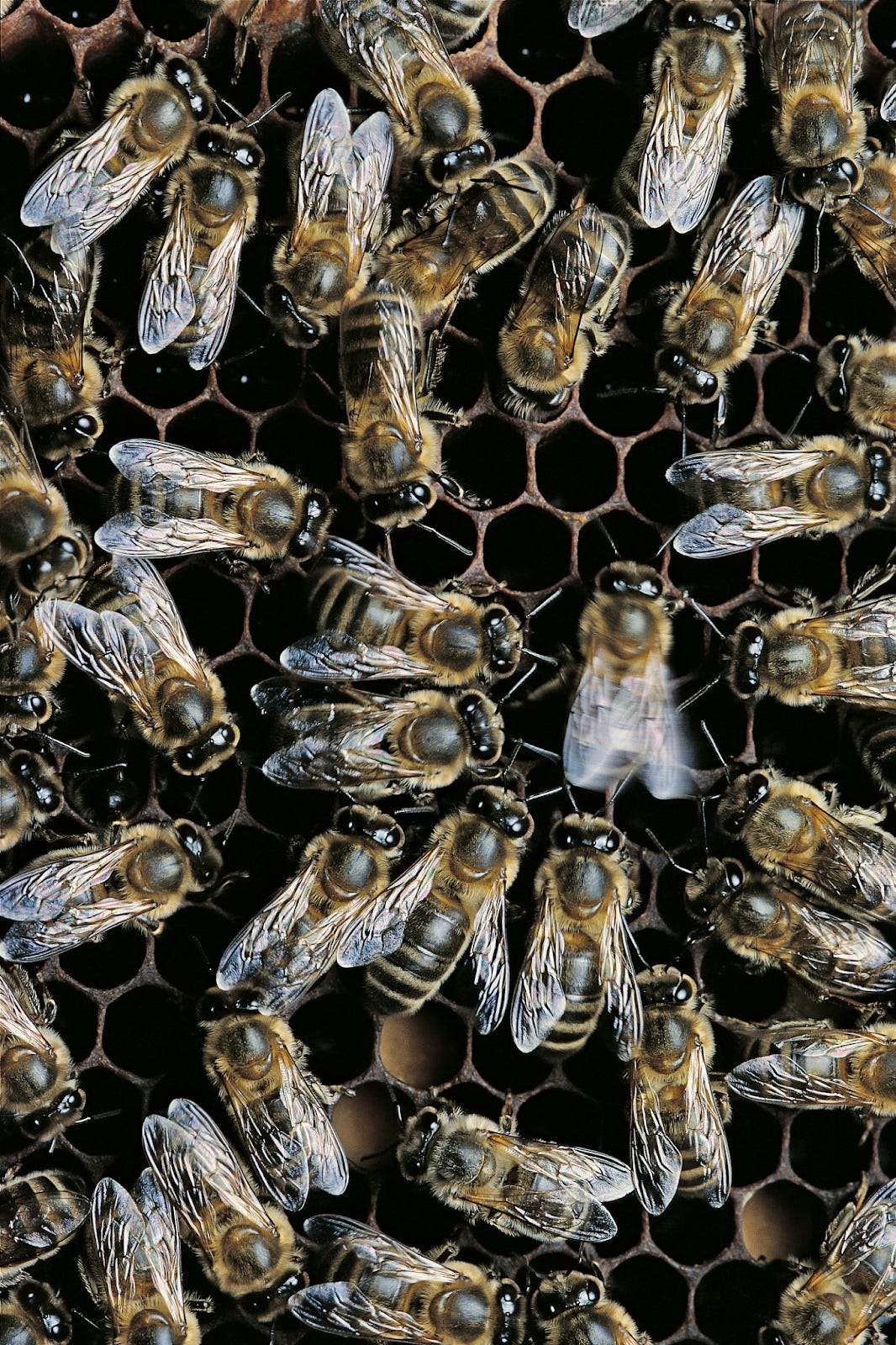
Consider the honey bee.
A hive survives by finding food efficiently, but the world it lives in is not static. Flowers bloom and die. Fields dry up. New opportunities appear without warning. If bees only exploited the best-known food source, they would thrive briefly and then starve. If they only explored endlessly, they would waste energy and accomplish nothing. Their survival depends on doing both, at the same time.
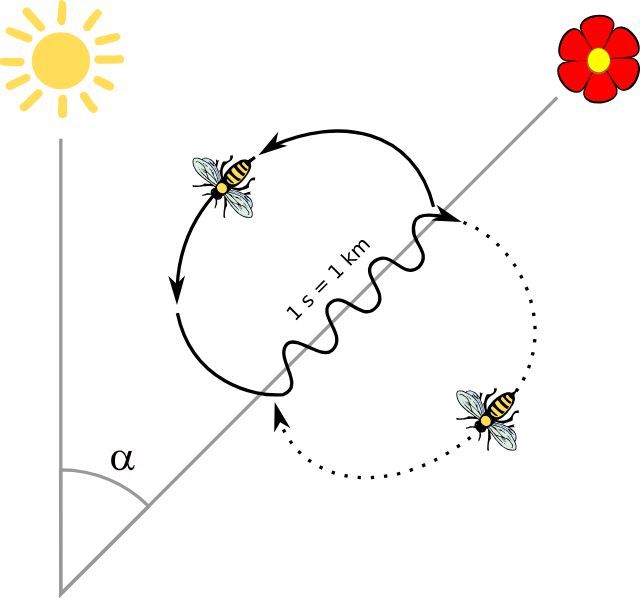
Bees solve this with one of the most elegant communication systems in nature: the waggle dance. When a forager finds a promising food source, it returns to the hive and performs a dance that encodes both direction and distance. The intensity of the dance reflects the quality of the find. Other bees watch and decide whether to follow.
What’s easy to miss is what doesn’t stop happening. Even when a rich source is discovered and heavily exploited, some bees keep exploring. No announcement is made that exploration is “done.” No quarterly planning meeting reallocates 100% of capacity to the current best option. The hive maintains a persistent minority of scouts, continuously sampling the unknown.
This is not inefficiency. It is insurance.
For product leaders, this maps uncomfortably well to the way teams behave under pressure. When metrics are strong and customers are happy, exploration often feels like a luxury. When things are going poorly, it feels irresponsible. In both cases, the instinct is to exploit harder, to optimize the known, to squeeze more value out of the current system. Bees would recognize this instinct immediately. They would also recognize the danger.
The hive does not survive by being right once. It survives by continuing to learn.
If bees give us the intuition, mathematics gives us the language.
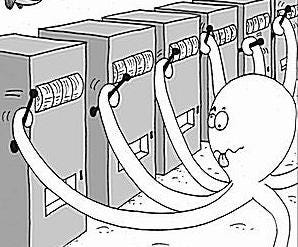
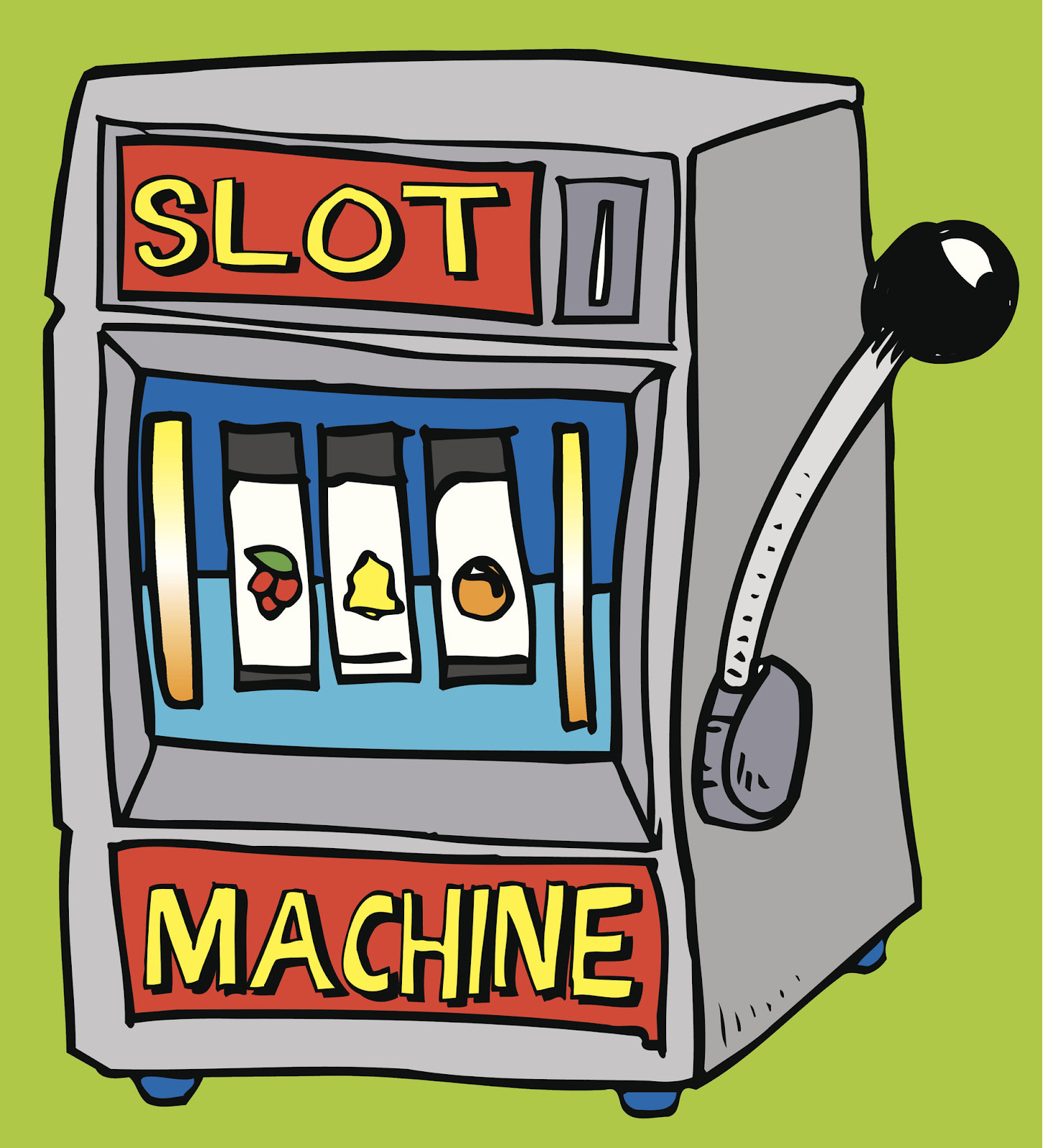
The multi-armed bandit problem is a classic formulation in decision theory. Imagine a row of slot machines, each with an unknown payout rate. You can pull any arm you like, but every pull costs you something. Pulling an arm gives you information, but also commits you to the outcome. Over time, you want to maximize total reward.
The dilemma is you cannot know which arm is best without pulling them, but every pull of a bad arm feels like waste. Pull the same arm repeatedly and you exploit what you know. Try new arms and you explore what you don’t. Too much exploitation too early locks you into a suboptimal choice. Too much exploration too late leaves value on the table.
What makes this problem powerful for product leaders is that it captures something uncomfortable: learning is expensive by definition. The cost is not just time or money, but opportunity. Every team assigned to explore is a team not working on something proven. Every sprint spent exploring is a sprint not spent optimizing.
Yet the math is unforgiving. Strategies that minimize short-term regret perform worse over time. The optimal approach deliberately accepts local inefficiency in service of global performance. In other words, exploration feels wrong precisely when it is most necessary.
This is where many product organizations quietly fail. They understand the theory. They nod at the metaphors. But their structures, incentives, and team designs push relentlessly toward exploitation. Roadmaps fill with features that improve known metrics. Teams are rewarded for predictability and punished for variance. Experiments are tolerated as long as they are small, fast, and disposable.
The result is what I’ve written about before in the context of short-term versus long-term bets. The portfolio drifts. Not because anyone decided to abandon the future, but because the system made that outcome inevitable.
Team topology plays a significant role in this drift.
How you organize teams largely determines whether exploration can exist. A single team asked to both exploit and explore will almost always choose exploitation, especially under delivery pressure. The urgent crowds out the important. Bugs, escalations, and roadmap commitments have a way of consuming any slack that was theoretically reserved for exploration.
On the other extreme, carving out a separate “innovation” team can create the illusion of exploration without its substance. These teams often lack ownership of outcomes, access to real customers, or a path for their work to influence the core product. They explore in isolation, generating ideas that struggle to find a home.
The most effective organizations I’ve seen treat exploration and exploitation as different modes with different needs, but not different levels of importance. Teams oriented toward exploitation are designed for stability, throughput, and reliability. Their success comes from deep context, tight feedback loops, and continuous improvement. Teams oriented toward exploration are designed for learning speed. Their success comes from exposure to uncertainty, permission to be wrong, and time to run multiple pulls of the lever.
Crucially, there is an intentional path between the two. Exploratory work that shows promise does not remain experimental forever. Like a strong waggle dance, it attracts more attention. Resources follow signals, not hope. Over time, bets graduate from explore to exploit, from fragile to durable.
This transition is where leadership matters most. Without active stewardship, exploration becomes theater and exploitation becomes stagnation. The portfolio needs constant rebalancing, not because leaders lack conviction, but because the environment keeps changing.
One of the most subtle failure modes occurs when organizations believe they are exploring, but are really just re-labeling exploitation. Incremental improvements masquerade as innovation. Small optimizations are sold as big bets. The language of exploration is adopted without its risk. This is comforting, but it is not adaptive.
Real exploration produces discomfort. The metrics are noisy. The outcomes are uncertain. The timelines are unclear. These are not bugs in the process; they are signals that learning is happening.
Nature understands this. Bees do not demand certainty from scouts before listening. They amplify based on evidence. They accept that some foragers will return empty-handed. The cost of those failures is built into the system.
Product organizations that last do the same.
They do not ask every team to be everything at once. They design for different kinds of work, and they protect each mode from being overwhelmed by the other. They acknowledge that exploitation pays the bills, but exploration pays the future.
Perhaps the most important shift is psychological. Leaders must stop treating exploration as a phase that ends. There is no point at which the environment becomes stable enough to stop learning. Markets move. Technologies evolve. Customer expectations shift. The moment you believe you have arrived is usually the moment decline begins.
This is why the exploit versus explore tension never resolves. It is not a problem to be solved, but a dynamic to be managed. Like leadership in a flock, or foraging in a hive, it requires constant adjustment rather than a fixed answer.
If there is a single takeaway I hope you sit with, it is this: your roadmap is not a plan, it is a portfolio. And portfolios require diversification, patience, and a tolerance for uncertainty.
Bees don’t optimize themselves into extinction. Wise gamblers don’t expect every lever to pay out. And resilient product organizations don’t confuse short-term efficiency with long-term survival.
The question is not whether you should exploit or explore. The question is whether your system allows you to do both, honestly, continuously, and without apology.
This is really wonderfully written Mike!
Grateful for learning about the bees that never stop exploring! Nature showing how a company of bees survives over time should convince companies of people, right!?