
Culture Debt
The Invisible Interest of Speed

In the early days of Uber’s rise, the story was simple: build fast, hire fast, expand fast. Travis Kalanick embodied speed as a leadership philosophy. It became the company’s competitive weapon, and its cultural center of gravity. “Always be hustlin’” wasn’t just an attitude, it was an operating model. And for a while, it worked flawlessly. Cities opened. Riders flooded in. Valuations soared.
But inside the company, the invisible interest payments were accumulating.
Rapid hiring meant uneven management. Hyper-aggressive targets shifted norms from ambition into intimidation. HR became overwhelmed, then sidelined. Behavior that would have been unacceptable elsewhere was tolerated if it produced results. And when engineer Susan Fowler published her now-famous blog post in 2017, exposing harassment and systemic neglect, the debt came due all at once.
Uber could rebuild its business. It could replace its CEO. It could rebrand. But it could not easily repair the psychological safety, trust, and behavioral norms that had eroded over years.
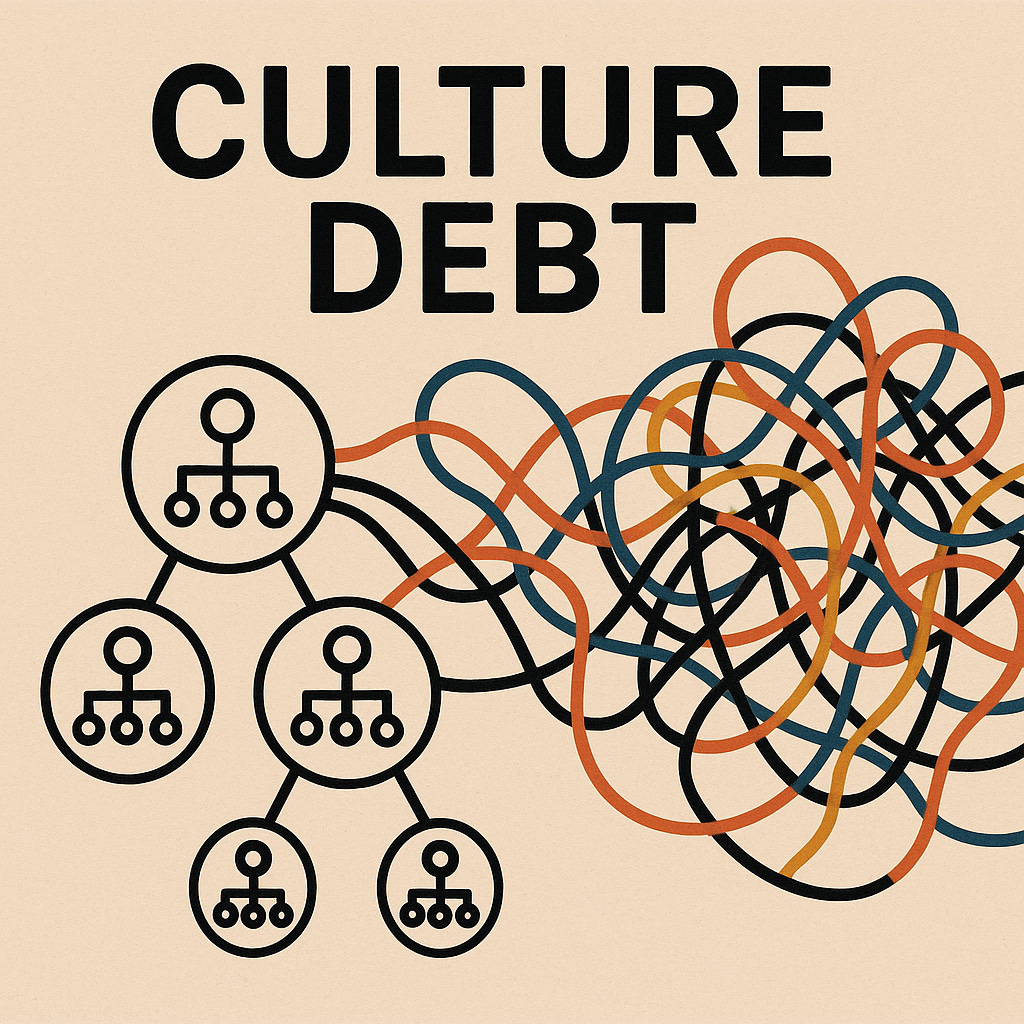
This is culture debt: the hidden cost of neglecting the systems that govern how people work together. You don’t notice it at first. Then suddenly, you can’t ignore it.
What Culture Debt Is (And Why It’s Inevitable)
Technical debt, as I’ve written before, isn’t a moral failing, it’s a strategic tradeoff. You cut a corner today to move faster, knowing you’ll need to revisit that corner tomorrow. The danger isn’t the debt itself, but ignoring its interest.
Culture debt works the same way, except the corners you cut aren’t in code, they’re in norms, expectations, and relationships. And people, unlike software, don’t forget. They also don’t refactor easily.
A great contrast to Uber’s experience is Netflix’s early Culture Deck, which Reed Hastings and Patty McCord created not as a manifesto but as an act of maintenance. As Netflix scaled, they realized the company’s once-clear cultural assumptions were beginning to drift. So instead of letting culture evolve silently through departmental folklore, they made the implicit explicit:
Here’s how we work.
Here’s what we value.
Here’s what we will never tolerate.
Here’s what “freedom and responsibility” looks like in practice.
Most companies only write their values during onboarding. Netflix rewrote theirs continuously as the organization changed.
That’s the opposite of culture debt. That’s culture upkeep.
Culture debt accumulates when leaders assume culture will scale on its own.
It never does.
How Culture Debt Accrues: The Small Compromises
Culture debt rarely accrues through dramatic events. It builds gradually, through decisions that seem efficient in the moment.
Take Wells Fargo.
For years, the company publicly championed customer-first values. But internally, sales quotas overshadowed everything. Employees were told to hit numbers that were mathematically impossible without bending rules. Managers learned to look the other way. Executives rewarded the outcomes while ignoring the process.
Eventually, millions of fraudulent accounts were opened to meet targets. Billions in fines followed. The scandal wasn’t a sudden failure, it was the interest accumulated from years of cultural drift.
This is the hallmark of culture debt:
What you reward diverges from what you say you value.
People adapt to survive.
The organization reaps short-term gains and long-term damage.
Just like a metric optimized without context, culture optimized without alignment has unintended consequences.
The Symptoms: When the Debt Comes Due
The most dangerous thing about culture debt is how quietly it grows, until it suddenly shapes everything.
Few companies illustrate this better than Boeing.
For decades, Boeing was synonymous with engineering excellence. But as priorities shifted toward cost efficiency and financial performance, cultural cracks emerged: safety concerns minimized, engineers discouraged from escalating issues, and internal dissent seen as an inconvenience rather than signal.
The results were tragic: two fatal 737 MAX crashes and a loss of trust so severe it shook the entire aviation industry. Years later, even after intense scrutiny, an Alaska Airlines 737 MAX rolled out of the factory missing critical bolts, proof that cultural issues left untreated have a long half-life.
Boeing shows the true cost of culture debt:
Decisions become inconsistent.
Risks get normalized.
Communication fractures.
High performers leave.
The system resists change.
By the time an organization sees the symptoms, the debt has already compounded.
Why Culture Debt Is More Dangerous Than Technical Debt
Technical debt slows teams; culture debt divides them. Code can be refactored. Architecture can be rewritten. But cultural damage resides in trust, and trust is slow to rebuild.
Consider what happened at Twitter after the 2022 ownership change.
The new leadership demanded extreme speed and intensity, reversing years of established norms overnight. Employees suddenly didn’t know which values still applied. Psychological safety evaporated. Communication became reactive rather than collaborative. Thousands of high performers self-selected out.
It wasn’t the speed that caused the crisis. It was the cultural whiplash. The company already had cultural liabilities, misalignment, silos, and uneven accountability, and the abrupt shift magnified them. When norms collapse faster than people can adapt, the entire system destabilizes.
This ties directly to what I’ve written about change: without psychological safety and trust, transformation becomes chaos.
Culture debt isn’t just harder to fix than technical debt,
it can make technical solutions irrelevant.
How to Pay Down Culture Debt
If culture debt grows accidentally, culture health grows intentionally. And the best example of this in action is Slack’s origin story.
Slack didn’t emerge to fulfill a grand vision. It grew out of the ruins of a failed video game. But what Stewart Butterfield and his team did differently was listen. They treated every unexpected user behavior as signal. They built rituals of reflection into the company’s DNA. They embraced curiosity over certainty.
That mindset, continuous learning rather than defensive execution, is what prevents culture debt.
Here’s how leaders can build the same resilience:
Make culture a C-suite responsibility - Not HR’s job, not onboarding’s job, but leadership’s job. Like tech debt, culture debt responds only to deliberate attention.
Define norms, not slogans - Values don’t matter unless they describe observable behaviors. “Ownership,” “respect,” and “excellence” mean nothing unless teams can articulate how they show up in meetings, decisions, and tradeoffs.
Keep reflection rituals sacred - Retros, postmortems, skip-levels, these aren’t administrative tasks. They are culture maintenance. Without them, drift is guaranteed.
Reward truth-telling early - Employees should see honesty as a contribution, not a risk. Psychological safety isn’t about comfort; it’s about enabling candor without fear of punishment.
Reassess cultural assumptions regularly - Just as systems change, so do people. Revisit norms the same way you revisit build vs buy decisions, because the solution that worked last year may now be the bottleneck.
The Debt You Can’t Ignore
Every organization carries culture debt. The healthy ones pay attention to it. The unhealthy ones discover it only when the cost becomes too great to ignore.
Speed isn’t the enemy. Growth isn’t the enemy. The real danger is assuming culture will take care of itself while the organization races ahead.
Technical debt slows code.
Culture debt slows people.
And people are always the hardest to scale.
If you want acceleration that lasts, invest in the culture that enables it.
Really nice piece, Mike. And very well written.
A lot of this (as with most things actually) comes back to intentionality and awareness. Culture inevitably has to change with scale, and sometimes decisions that are right in the moment will jar with the intended culture.
What matters is noticing it and continuing to talk about it, both within the leadership team and openly across the company. The problems tend to show up when leaders try to cling to an original culture that no longer fits, or when culture just happens as a byproduct of decisions rather than something they actively shape.
P.S. You also inspired me last year to start my own Substack and get back to writing!
Wow, I love this in so many ways.
First of all, just the fact that you’re addressing it so directly and eloquently is significant. This topic hits close to the bone for so many companies. Who hasn’t experienced the back-burnering of culture care under duress, which is arguably when you need it most!
Also, I appreciate the comparison of culture debt to tech debt. While tech debt is at its best, strategic tradeoffs, culture debt is, at its core, a trust issue. It reminds me of the quote that trust is gained in drops and lost in buckets.
Thanks for taking the time to write, Mike. I’ve really been enjoying it. It’s a treat to read useful content so well articulated.