
A Small Problem
What a pilot gliding a powerless 747 understood about leading

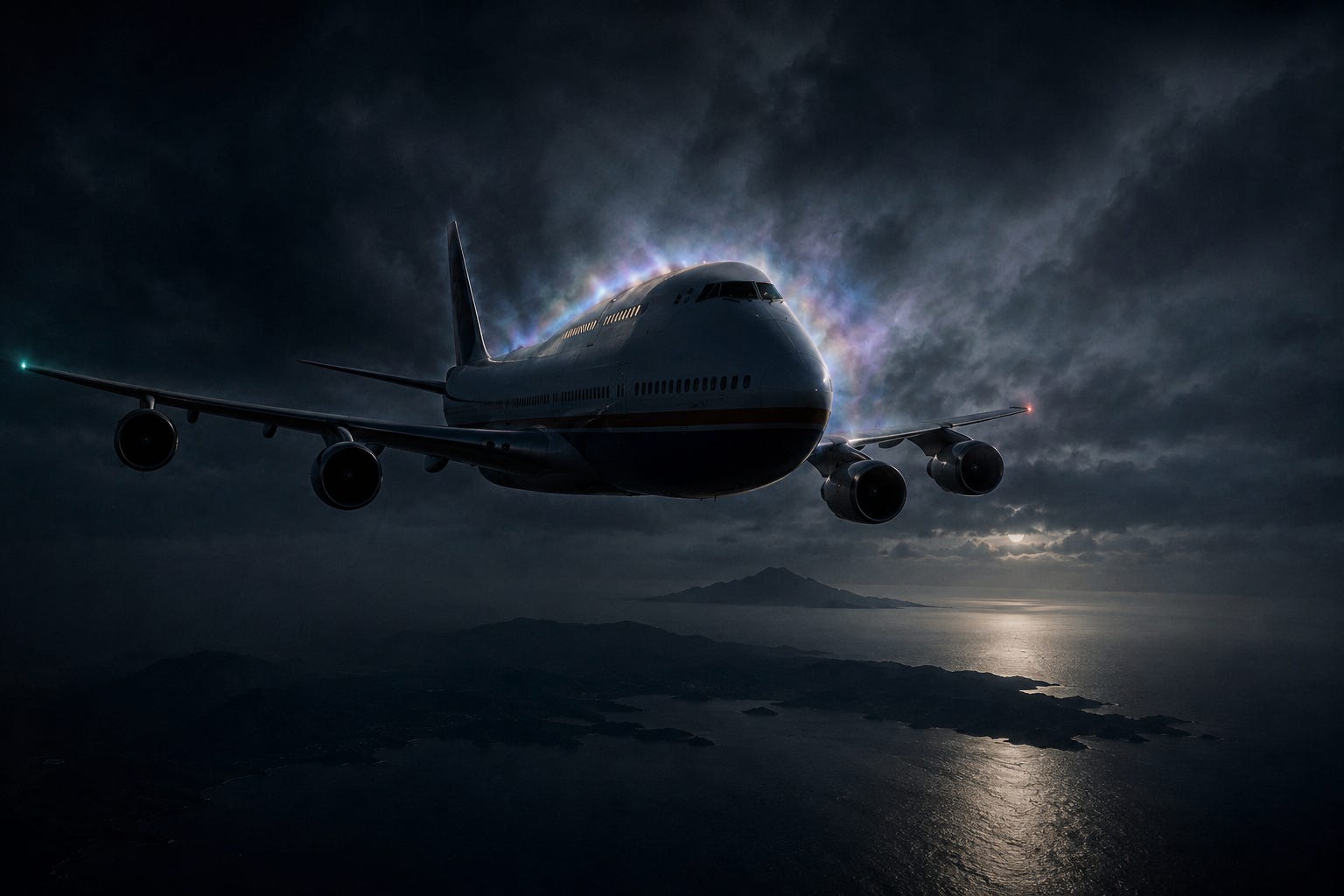
On the night of June 24, 1982, a British Airways 747 named City of Edinburgh was somewhere over the Indian Ocean, cruising at 37,000 feet on the leg from Kuala Lumpur to Perth, when it flew into an invisible cloud of volcanic ash thrown up by the erupting Mount Galunggung. The ash did not register on the weather radar, which was tuned to find moisture, not powdered rock. The crew first noticed an eerie glow around the nose, like St. Elmo’s fire, and then, one by one, the engines began to die. Number four surged and quit. A minute later, number two. Within seconds, one and three. All four engines on a fully loaded jumbo jet, gone, at night, over the ocean, with 263 people on board and the mountains of Java waiting somewhere below in the dark.
A 747 with no engines is not really a plane. It is a several hundred ton glider with a glide ratio of about fifteen to one. The crew had minutes.
This is the moment Captain Eric Moody, who died in 2024, is remembered for. He keyed the cabin intercom and said, in the flattest, most unbothered voice imaginable: “Ladies and gentlemen, this is your captain speaking. We have a small problem. All four engines have stopped. We are doing our damnedest to get them going again. I trust you are not in too much distress.”
A small problem.
It has been called the greatest passenger announcement in aviation history, and the reason it works is the gap. The gap between what was actually happening, four dead engines and a slow fall toward the sea, and what he chose to transmit, mild British inconvenience. I have written before about why great leaders grow calmer as the stakes rise, the internal mechanics of composure, the thermostat instead of the thermometer. This piece is about something narrower and stranger that Moody understood in his bones: composure is not only a state you are in. It is a signal you broadcast. And the broadcast is a separate job from solving the problem.
Two jobs, not one
Most leaders think a crisis hands them a single job: fix it. Moody had two, and he never let them blur together. One job was to fly the airplane, run the relight drills, set up an approach, get the mayday out. The other job was to run the cabin. Those are not the same task, and they do not get the same words. The cockpit that night was anything but calm. The first officer was working the radios, the flight engineer was cycling restart attempts, and Moody had set a hard decision height of 12,000 feet: if the engines had not relit by then, they would stop trying to clear the mountains and ditch in the sea. That is not serenity. That is a man working a desperate problem fast. The “small problem” voice was not what he felt. It was what he decided the people behind him needed to hear so that none of them opened a door, rushed an aisle, or made his real job harder.
That is the part most leaders miss. Calm in a crisis is not a mood that descends on you. It is a deliberate act of transmission, aimed at a particular audience, for a particular operational reason.
Match the message to the channel
Pilots are taught a priority order for emergencies: aviate, navigate, communicate. Fly the plane first, decide where you are going second, talk third. Communicate comes last not because it is unimportant but because it is the step most likely to get skipped when the adrenaline lands, and the one most likely to do harm if you botch it. Moody’s gift was that he did not skip it and he did not botch it. He matched the message to the channel. The cabin got reassurance. The cockpit got the truth.
In an organization you are always broadcasting on more than one channel at once, whether you intend to or not. Your exec team needs the unvarnished situation. The wider company needs enough to stay oriented without spinning out. Customers need a different message again. The failure mode is not the absence of a calm voice. It is using one voice for everyone: either feeding the cockpit a soothing story or dumping the cockpit’s panic straight into the cabin. Calm is contagious, and so is fear. Whichever one you transmit is the one that spreads.
The dangerous twin
Here is where the Moody story stops being a feel-good fable and gets useful.
The exact instinct that makes Moody great, the instinct to downscale, to say “small problem,” is the same instinct that, pointed the wrong way, gets people killed.
Two decades after Moody, Boeing built the 737 MAX with a new flight control system called MCAS. To keep the jet commercially competitive, Boeing wanted to avoid triggering expensive new pilot training, so the change got framed as minor. MCAS was left out of the standard pilot manuals. It was allowed to fire on a single angle of attack sensor, with no redundancy. Most pilots were never told it existed. The whole posture was a corporate version of “we have a small problem,” except this time the understatement was not aimed at a cabin that could do nothing anyway. It was aimed at the exact people who would have to act when it went wrong: the pilots and the regulators. The cockpit. Two airplanes went down. 346 people died.
That is the line, and it is razor thin. Moody downscaled the emotion he transmitted. He never downscaled the information the people who had to act actually needed. He told the cabin “small problem” precisely because there was nothing the cabin could do, and he told the cockpit everything because the cockpit had to do all of it. Boeing did the reverse. It soothed the very people who needed the truth.
Understatement aimed at people who cannot act is composure. The identical understatement aimed at people who must act is denial. From the inside they feel exactly the same, which is what makes the second one so easy to commit while congratulating yourself on being a steady hand.
Steadiness needs a plan B, and an honest sentence
Notice the other thing Moody had that Boeing’s framing lacked: a real fallback, named out loud, with a trigger. Decision height 12,000 feet, then ditch. I argued in No Plan B that the move is to separate unwavering vision from flexible execution, to commit absolutely to the destination while staying humble and reversible about the route. Moody was committed to exactly one outcome, get everyone down alive, and he carried two routes to it, relight and land or glide and ditch, with a clear line for switching between them. He was not less calm for holding a plan B. He was calmer because of it. Anxiety shrinks the moment it becomes specific.
The announcement itself was a small masterclass in what I called alignment without illusion. He did not lie. “All four engines have stopped” is the literal truth, delivered plainly. He did not promise an ending he could not guarantee. He committed only to the thing he could actually stand behind, “we are doing our damnedest,” which is an honest statement of effort rather than a manufactured certainty. That is “promise hygiene” at 12,000 feet: steady the room with the truth, not with a comforting fiction you will have to walk back at the funeral.
The work, before the engines quit
So here is the assignment, and it is work you do before anything fails, not during.
First, decide your decision height now. What is the line, named in advance, at which you stop trying to relight and commit to the fallback? Pick the number while you can still think clearly, because you will not invent it cleanly on the way down.
Second, write your “small problem” sentence. Not the panicked version, not the corporate non-answer, but the one true, plain, unbothered line you will say to the cabin when it all goes to hell. Then decide who your cabin actually is and who your cockpit actually is, and resolve, right now, that you will never confuse the two.
And then sit with the hard question, the one that separates composure from its twin. The next time you catch yourself saying “we’ve got this,” stop and ask which it is. Are you steadying a room that needs to keep functioning while you and a few others do the real work? Or are you quietly telling the people who could actually fix this that there is nothing to fix, because the calm voice is easier to use than the honest one?
Moody’s passengers landed at Jakarta on a jet with windscreens so sandblasted the pilots had to peer through the side windows to find the runway. The people in the back did not learn how close it had been until much later. That is what it looks like when a leader carries the fear so the people who cannot act do not have to, while handing the people who can act the entire brutal truth.
A small problem. Say it to the right people, for the right reason, and it is the most reassuring sentence in the world. Say it to the wrong people, to spare yourself the harder conversation, and it is the last thing some of them will ever hear.
This is one of your best!
Mike, this article is such an important piece. The "most important statement in aviation history" “Ladies and gentlemen, this is your captain speaking. We have a small problem. All four engines have stopped. We are doing our damnedest to get them going again. I trust you are not in too much distress.” I love this, instead of "Uh, folks, you might want to say some prayers and think of your loved ones right about now..."
I liken this to watching my favorite NFL team fumbling the ball on the 2 yard line and having the opposing team scoop it up and run back 98 yards for a score, all while there are only 50 seconds left in the game and my team being down by 4 points (after the 7 points added from the opposing team's score).
The Quarterback, (not the Head Coach) is suddenly the focus of "now what?!!" Well, here's the deal: If the QB goes into the huddle and shows the slightest nervousness, people will notice, and then breaking the huddle and approaching the line with sweat running down his face, people will notice. On the other hand, if the QB assuredly fist-pumps his offence going into the huddle, and then calmly breaks huddle and walks up to the line, confidently observes the defense, looks at his offense line and then commands the play call without sounding like a panicked youngster - the people will notice. Either scenario, the people (coaches, players, fans) will notice!
It's not the reaction to a crisis that gets the attention, as much as it's watching with intent the movement of the ones in charge that DO get noticed.
Again, what you wrote: "Calm in a crisis is not a mood that descends on you. It is a deliberate act of transmission, aimed at a particular audience, for a particular operational reason." And: "The failure mode is not the absence of a calm voice. It is using one voice for everyone: either feeding the cockpit a soothing story or dumping the cockpit’s panic straight into the cabin. Calm is contagious, and so is fear. Whichever one you transmit is the one that spreads." Amen to that.
I so appreciate how well you articulate these most salient points. Some people don't take the time to understand what 'assurance' means personally, and some are well attuned to it, especially when an emergency happens. Some think one must be "educated" to know the mechanisms of doing an efficient job under duress, and no doubt education is a prerequisite in most jobs, but being gifted with knowing the instinctual craft of dealing with a crisis and executing it with calm, is well... I guess a gift after all. Clearly, the pilot in this article was a gifted Captain!
Thanks, as always Mike, your articles are Spot On!